


Beyond 20/20: How Sports Vision Training Gives Fall Athletes an Edge
Beyond 20/20: How Sports Vision Training Gives Fall Athletes an Edge
As late summer rolls around, student-athletes across soccer fields, football gridirons, and volleyball courts in Ashburn and beyond are gearing up for the fall season. Conditioning drills, tactical playbooks, and weightroom sessions dominate pre-season schedules. But there is a crucial athletic component that often gets completely overlooked: visual performance.
Most parents and student-athletes assume that having "20/20 vision" means their eyes are fully ready for competition. However, 20/20 is merely a measure of static visual acuity—how clearly you can read a stationary eye chart while standing perfectly still in a quiet exam room.
On the field, nothing stays still.
What is Sports Vision Training?
Sports vision training consists of specialized, science-backed eye exercises designed to train the brain and eye muscles to process visual information faster and more accurately. Just as an athlete trains their quads to explode out of a sprint, they can train their visual system to track rapid movements under pressure.
Key Visual Skills Trained in Sports Vision
Dynamic Visual Acuity (DVA): The ability to see moving objects clearly while you—or the object—are in rapid motion.
Soccer Impact: Tracking a curling corner kick while sprinting into the box.
Depth Perception & Binocularity: How well both eyes work together as a team to judge distance and speed accurately.
Football Impact: A quarterback sizing up the distance between a charging linebacker and a receiver running a route.
Hand-Eye-Body Coordination: The speed at which your brain interprets a visual signal and directs your muscles to react.
Volleyball Impact: Digging a spike traveling at high speeds before it hits the hardwood.
Peripheral Vision & Spatial Awareness: Recognizing open space, teammates, and opponent movements out of the corner of your eye without turning your head.
Field Breakdown: How It Elevates Fall Sports
Different sports place unique demands on an athlete's eyes. Here is how specialized vision training supports key fall sports:
Soccer: Improves 360-degree awareness and fast ball trajectory tracking. Expanding the peripheral field allows players to spot open teammates faster and judge long-range passes accurately.
Football: Enhances high-speed tracking through helmet face masks. Sharpens dynamic acuity and depth perception under chaotic field conditions.
Volleyball: Trains millisecond reaction times and overhead tracking. Fine-tunes hand-eye motor response for crisp setting, precise serving, and defensive digs.
Protecting Your Visual Edge: Athletic Eyewear
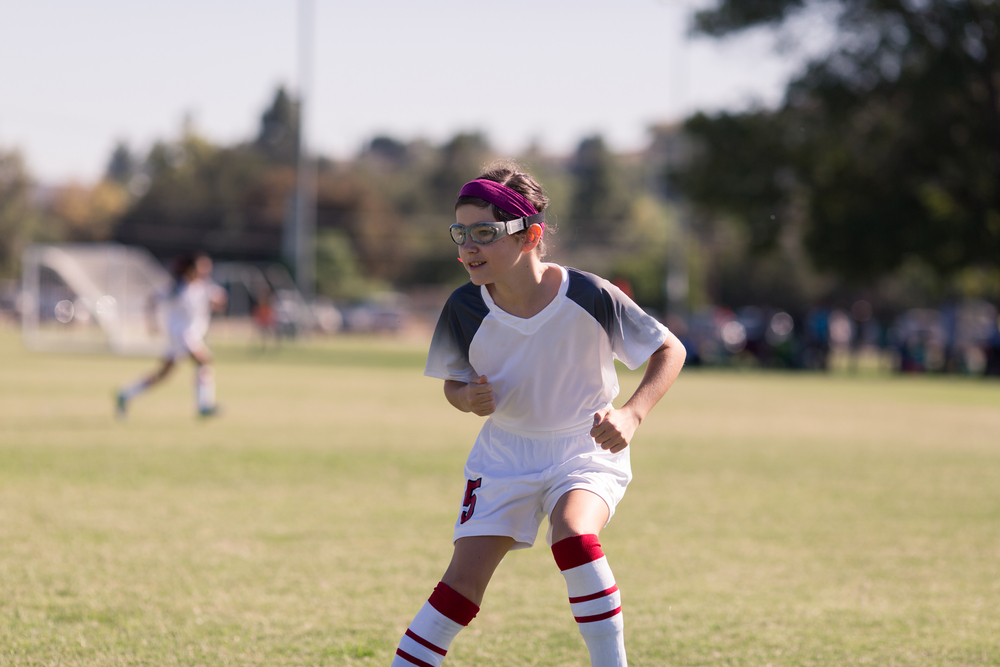
Training your visual system is only half the battle—protecting it on the field is equally critical. Thousands of sports-related eye injuries occur annually among school-aged athletes, with soccer, basketball, and racquet sports near the top of the list.
Standard everyday glasses or contact lenses often don't provide adequate protection against direct contact, blunt force trauma, or stray fingers during intense play.
What to Look For in Fall Sports Eyewear:
ASTM F803 Certification: Look for protective goggles specifically rated to withstand high-velocity impacts from sports equipment and physical contact.
Polycarbonate Lenses: Highly shatter-resistant material that shields eyes from blunt force while providing 100% UV protection for outdoor games.
Non-Slip Fit & Straps: Adjustable neoprene straps ensure frames stay locked in place under football helmets or during rapid volleyball dives.
Anti-Fog Coatings: Built-in ventilation channels and anti-fog technology keep vision crisp during high-humidity August pre-season practices.
❓ Frequently Asked Questions (FAQ)
Q: My child has 20/20 vision. Do they still need sports vision training?
A: Yes. Standard 20/20 vision only measures visual sharpness at a static distance while standing still. It does not measure how fast the brain processes visual inputs, how well the eyes track a moving ball, or how accurately an athlete judges depth while sprinting.
Q: Can sports vision training be done with prescription lenses or contacts?
A: Absolutely. Sports vision drills are performed while wearing corrective lenses (such as contact lenses or prescription sports goggles) so the athlete trains their visual system using optimal clarity.
Q: What is the ideal age to start sports vision drills?
A: Athletes as young as 8 or 9 can benefit from foundational hand-eye and tracking exercises. High school and collegiate athletes see significant improvements in reaction speed and decision-making time when integrating vision drills into their seasonal routine.
Gear Up for the Season at Optics & EYECARE
Before the opening whistle this fall, schedule a comprehensive eye exam and sports vision assessment with Dr. Seema Mohanan and the team at Optics&EYECARE in Ashburn, VA. Whether you need custom prescription protective goggles or specialized visual performance guidance, our team is here to help your athlete play safer, smarter, and with complete clarity.
Call us at 703-687-4719 or book your appointment at opticsandeyecare.com today!

All Eye
Care Services

Keep
In Touch
MAP
Powered by: 